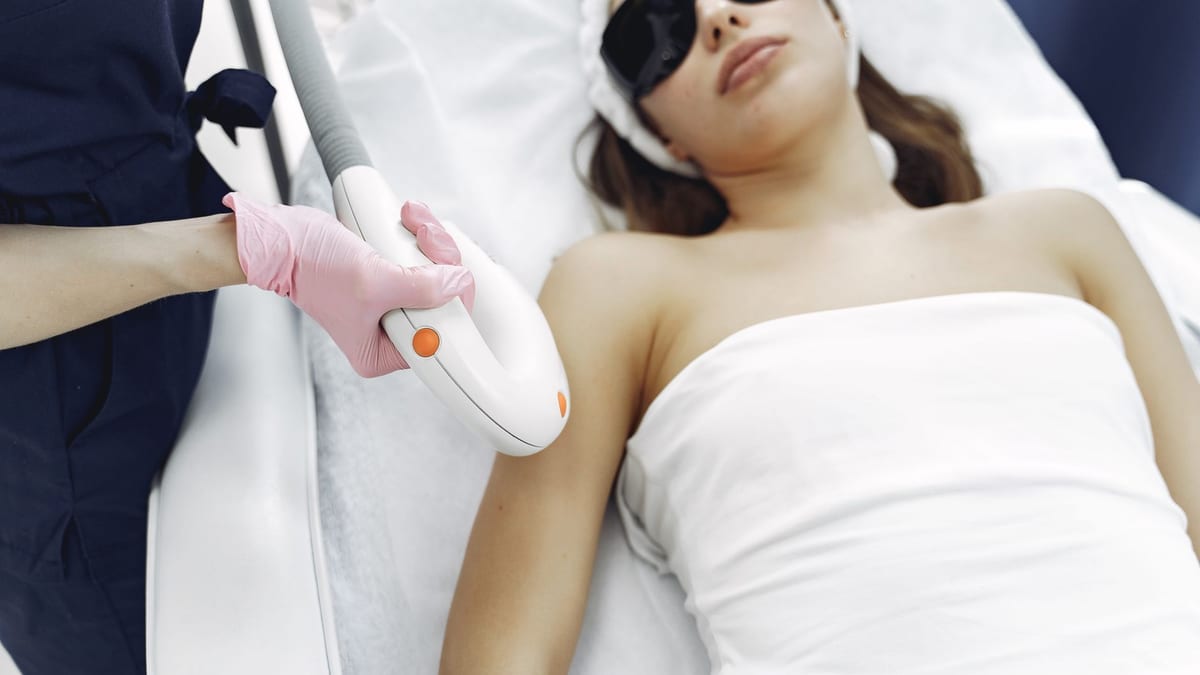
How Painful Is Laser Hair Removal? A 1-10 Scale by Body Area
Most laser hair removal pain answers are either "it's nothing" or a horror story. Here is the honest version: what each pulse actually feels like, a 1-10 rating for every body area, and the things that genuinely reduce it.
How painful is laser hair removal? For most people it lands around a 3 out of 10: a fast, hot rubber-band snap repeated across the area, done in minutes. Bony, thin-skinned spots like the upper lip and bikini line climb to a 6 or 7. Almost nobody rates it worse than waxing the same area, and it gets easier every session.
That is the short answer. Here is the detail, because “it depends on the area” is true but useless when you are trying to decide whether to book.
What the sensation actually is
Laser hair removal works by sending a pulse of light into the pigment in your hair. The pigment absorbs it, converts it to heat, and that heat damages the follicle. What you feel is that heat, arriving fast and leaving fast.
The two most common descriptions patients give:
- A rubber band snapped against the skin, then a half-second of warmth
- A tiny fleck of hot oil landing on you, like standing too close to a frying pan
Each individual pulse lasts milliseconds. There is no cutting, no needle, and no sustained pressure. This is why laser is different from waxing even at the same peak intensity: with wax, the pain is a rip that keeps stinging afterward, and with laser it is a spike that is gone before you finish flinching.
Two separate things determine how bad a session feels, and people confuse them constantly:
- Peak intensity, which is how sharp any single pulse is. Driven by hair coarseness, hair density, and how thin the skin is over bone.
- Time on the clock, which is how long you sit there. An upper lip is 30 seconds. Full legs are 20 to 30 minutes.
A 6 out of 10 that ends in 30 seconds is a much smaller deal than a 3 out of 10 that runs for half an hour. Most people find the second one more draining.
Laser hair removal pain by body area
| Area | Typical rating | Session length | Why it rates that way |
|---|---|---|---|
| Lower legs | 2-3 / 10 | 10-15 min | Thick skin, plenty of padding, hair is coarse but spread out |
| Arms | 2-3 / 10 | 10-15 min | Similar to legs, finer hair means less heat |
| Stomach | 3-4 / 10 | 5-10 min | Usually fine hair, though the navel area is sharper |
| Back | 3-5 / 10 | 20-30 min | Comfortable across the middle, sharper over the shoulder blades and spine |
| Chest | 4-5 / 10 | 10-15 min | Dense coarse hair plus bone close to the surface at the sternum |
| Chin and jawline | 4-6 / 10 | 2-5 min | Coarse hormonal hair on thin skin over the jawbone |
| Bikini line | 5-6 / 10 | 5-10 min | Thin skin, dense dark hair, nerve-rich |
| Underarms | 5-6 / 10 | 1-2 min | The most concentrated coarse hair on the body, over very thin skin |
| Knees, shins, ankles | 5-6 / 10 | included with legs | Bone directly under the skin with almost no fat between |
| Upper lip | 6-7 / 10 | 30-60 sec | Thin skin over bone, dense follicles, one of the most nerve-dense areas |
| Brazilian | 6-8 / 10 | 15-20 min | Everything the bikini line has, in a larger and more sensitive area |
Two rules explain the entire table:
Coarse, dense, dark hair hurts more. More pigment means more absorbed energy, which means more heat delivered per pulse. This is the honest irony of laser: the hair that responds best to treatment is the hair that stings most going through it.
Skin over bone hurts more than skin over fat. Fat is a cushion. Ankles, shins, the sternum, the jaw, and the upper lip have almost none.
If you have PCOS or hormone-driven facial hair, expect the facial numbers to sit at the top of their range for the first few sessions. The hair is coarser and denser than average, which is exactly why laser is worth doing there.
Modern cooling changed this more than anything else
If someone tells you laser hair removal is unbearable, ask when they had it. Devices from ten or fifteen years ago fired without meaningful skin cooling, and the experience was genuinely rough.
Current systems handle it three ways:
- Contact cooling. A chilled sapphire tip presses on the skin before, during, and after each pulse. Common on diode systems.
- Cryogen spray. A burst of coolant fires milliseconds before the laser pulse, used on devices like the GentleMax Pro.
- Forced cold air. A separate machine blows chilled air across the area throughout the session.
Some systems also offer an “in-motion” or SHR mode, where the technician sweeps the handpiece back and forth at lower energy over multiple passes instead of firing single high-energy shots. It feels like a spreading heat rather than a series of snaps, and most patients rate it two to three points lower on the scale.
One honest caveat: comfort is not the only variable that matters. The device that suits your skin tone matters more. Deeper skin tones are usually treated with an Nd:YAG laser, which penetrates deeper and tends to feel more like a hot thud than a snap. That is the correct trade, because the alternative is a device that risks burns and pigment changes on darker skin. Ask which device the clinic will use on you and why, before you book. Our list of med spa red flags covers what a vague answer to that question tells you.
Things that genuinely reduce the pain
- Topical numbing cream. Over-the-counter 4% lidocaine, applied 30 to 45 minutes before and covered with plastic wrap, takes real edge off small areas. Many clinics also offer a stronger compounded cream. Use it the way the clinic instructs and only on the area being treated. Numbing cream applied thickly over large areas of the body is the one part of this treatment with a documented history of serious harm, so this is not a place to improvise.
- Timing around your cycle. Pain sensitivity is measurably higher in the days just before a period. Book mid-cycle if you can.
- A plain painkiller 30 minutes before. Acetaminophen or ibuprofen is enough for most people.
- Shaving properly the night before. This is not optional and it is not only about results. Hair left above the skin singes when the laser hits it, which both hurts more and smells like burning hair for the rest of the session.
- Asking for a lower first pass. A good technician will start conservative on a new area, check how you respond, and build energy from there. Asking for this is normal and nobody will think less of you for it.
- Skipping caffeine if it tends to make you jumpy. Anticipation is a real part of what you are rating.
What should not be part of the deal: pain that stays sharp after the pulse, a lingering burn, welts, or blistering. That is not toughness, it is energy set too high or the wrong device for your skin tone. Say something during the session, not after.
Does it get easier? Yes, and predictably
Session one is the worst one you will have. That is because session one is when you have the most hair, and hair is what absorbs the energy.
By session three or four, most areas are down 50% to 70% in density. There is simply less pigment in the field to convert light into heat, so the same settings feel noticeably milder. Patients who rated their underarms a 6 at the start commonly rate them a 2 or 3 by session five. The anxiety drops too, which is not nothing: knowing exactly what is coming removes a real chunk of perceived pain.
The exception is hormonal areas. Face and bikini hair can rebuild between sessions, especially if you stretch the gaps well past the 4 to 8 weeks your clinic recommends. Stretched intervals mean more density each visit, which means both worse results and a worse experience.
How it compares to waxing
For most areas, waxing the same patch is worse, and the reason is duration rather than peak. A wax strip is a sustained rip followed by 20 to 30 seconds of genuine burning. A laser pulse is over instantly.
The bigger difference is the timeline. Waxing is a moderate pain you sign up for every four to six weeks, indefinitely. Laser is 6 to 8 sessions, then occasional maintenance, then mostly nothing. Add up a decade of either one and the comparison stops being close. We ran the full cost and lifetime comparison in laser hair removal vs. waxing.
The cheapest way to find out how you handle it
The lowest-pain areas are also the cheapest, which makes a test run easy. An underarm or upper lip session runs $50 to $150, and a full package for a small area is typically $200 to $600. Larger areas move up fast: lower legs run $200 to $400 per session, and full legs $300 to $600. The full breakdown by area is in our laser hair removal cost guide, and you can check what those numbers look like in your own city with the cost calculator.
Booking one small area first tells you more in 60 seconds than any article can, including this one, and it costs less than a month of waxing.
Bottom line: laser hair removal is a 2 to 4 out of 10 for most of your body, a 5 to 7 for thin skin over bone, and briefly a 7 or 8 for a Brazilian on session one. It is fast, it is over the moment the pulse ends, it gets easier every visit, and it beats the alternative you are currently repeating every six weeks. Choose the clinic on the device and the operator, not on which one promises it will not hurt.
Find a Laser Hair Removal clinic near you
See the clinics in your city that offer it, compare reviews, and request a free consultation.
Your location is used once to pick the nearest city and is never stored.
Keep reading
What Med Spas Pay: Nurse Injector and Aesthetic Nurse Salaries by City
There is no official salary figure for a nurse injector. There is a floor, set by what hospitals pay registered nurses and nurse practitioners in your city, and a ceiling, set by how much revenue the injector brings in. Here are the floors in 18 metros, the pay structures that work, and the ones that quietly bankrupt clinics.
Read post → Treatment Deep DiveHow Long Does Laser Hair Removal Last? Years for Most Areas, With One Asterisk
After a full series, most people stay largely hair-free for years, and some areas never really come back. But nobody gets 100% forever. Here is the honest timeline by body area, the six reasons hair returns, and what a year of maintenance actually costs.
Read post → Patient GuideLip Filler Aftercare: What to Do, What Not to Do, and the Day-by-Day Healing Timeline
What should you do after lip filler? Ice gently, keep your head up, skip alcohol, hard exercise and heat for 24 to 48 hours, and do not judge the result for two weeks. Here is the day-by-day healing timeline, the full do-not list, and the few symptoms that are not normal.
Read post →Find Laser Hair Removal providers in your city
Compare vetted clinics with real Google ratings, see honest local cost ranges, and request a free consultation.