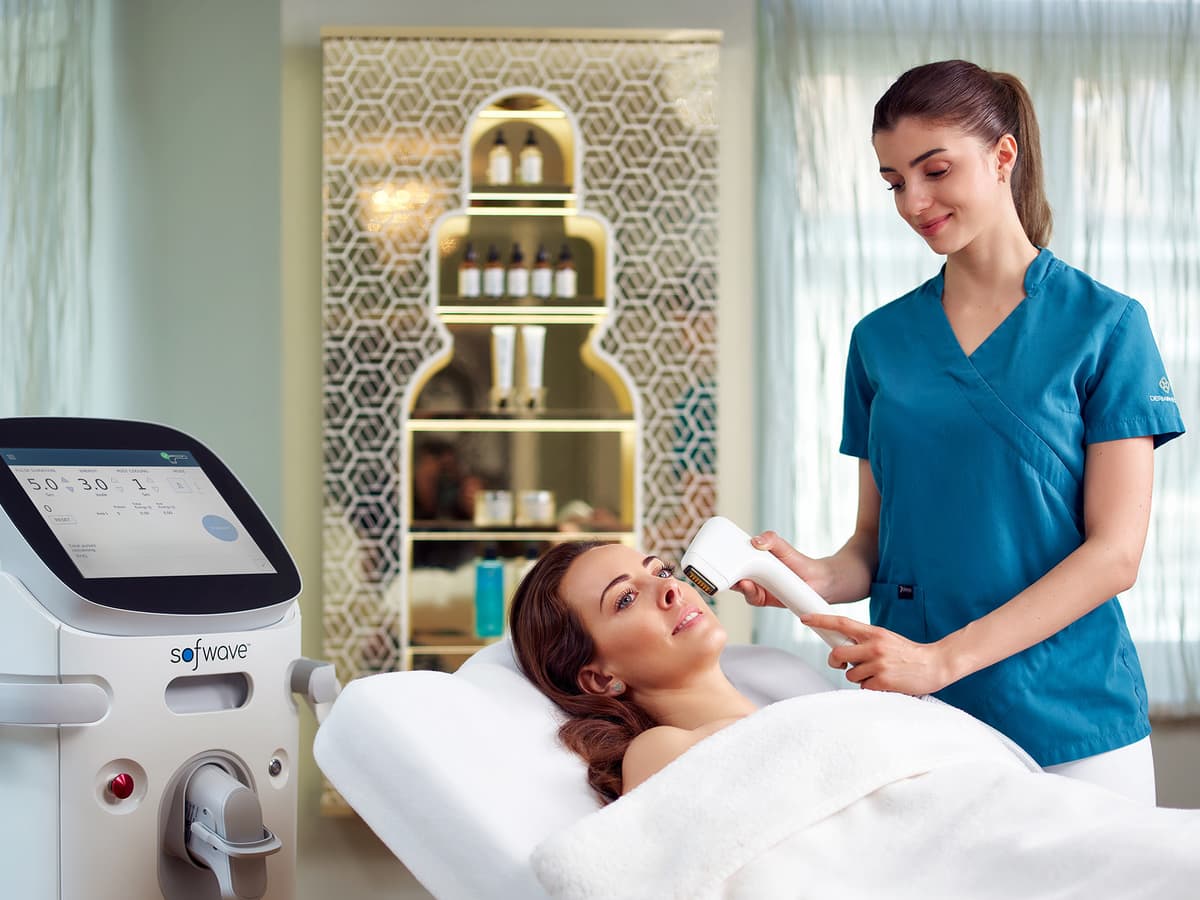
Non-surgical ultrasound and energy treatments like Ultherapy and Sofwave that lift and firm sagging skin on the face, neck, and brow by stimulating deep collagen.
Also called: Ultherapy, Sofwave, Thermage, ultrasound skin tightening, non-surgical lift
See the clinics in your city that offer it, compare reviews, and request a free consultation.
Your location is used once to pick the nearest city and is never stored.
Skin tightening treatments use targeted energy (most often ultrasound) to lift and firm loose skin without surgery, needles, or downtime. The best-known options, Ultherapy and Sofwave, work by heating the skin’s deeper structural layers to trigger fresh collagen production, gradually restoring firmness to the brow, jawline, neck, and under the chin.
How non-surgical skin tightening works
Both treatments deliver focused energy below the skin’s surface, bypassing the top layer so there’s no wound to heal:
Ultherapy uses micro-focused ultrasound that reaches multiple depths, including the SMAS, the same foundational layer a surgeon tightens during a facelift. By heating this deep tissue to a precise temperature, it contracts existing collagen and stimulates new collagen over the following months. It’s the only device FDA-cleared to lift the brow, chin, and neck and improve lines on the décolletage.
Sofwave uses ultrasound focused on the mid-dermis to firm skin, smooth fine lines, and improve overall texture. It’s often described as more comfortable and is well suited to early laxity and a refreshed, tightened look.
Because results rely on your body building new collagen, the lift develops gradually and looks natural: there’s no sudden “done” appearance.
What to expect during treatment
A session takes 30 to 90 minutes depending on the area and device. The provider applies the handpiece and delivers energy in lines across the treatment zone. With Ultherapy you may feel brief deep heat or prickling as each line is delivered, which signals the collagen-stimulating energy reaching the target depth; comfort measures keep it tolerable. Sofwave tends to feel warmer and gentler. Afterward, the skin may look slightly flushed or feel tender, but you can return to normal activity immediately: there’s no recovery period.
Results and timeline
Skin tightening is a gradual treatment:
Initial: Some immediate tightening from collagen contraction.
2–3 months: The primary lift and firming develop as new collagen forms.
Up to 6 months: Continued improvement.
A single session often delivers results that last a year or more, with annual maintenance recommended to keep pace with ongoing aging.
Is skin tightening right for you?
The ideal candidate has mild to moderate skin laxity (a softening jawline, early jowls, brow heaviness, or loose skin under the chin or on the neck) and wants a natural lift without surgery or downtime. If your skin laxity is advanced or you have significant excess skin, a surgical procedure will give a more dramatic result; these energy treatments are best for prevention and early-to-moderate concerns, or for extending the results of past procedures.
Risks and side effects
These are low-downtime treatments with a strong safety record. Temporary effects can include redness, swelling, tenderness, tingling, or (uncommonly) small areas of numbness or bruising that resolve over days to weeks. Very rare side effects, more associated with operator error, include nerve irritation. As always, an experienced, properly trained provider is the key to safe, effective, natural-looking results.
What affects the cost
Pricing depends on the device (Ultherapy vs. Sofwave), the area treated (full face and neck versus a single zone like the under-chin or brow), the amount of energy delivered, and your provider’s expertise and city. Full face-and-neck Ultherapy sits at the higher end of the range, while a single targeted area costs less. Because a single session can last a year or more, many people view it as an annual investment.
Lifts and firms skin with no surgery, incisions, or downtime
Ultherapy is FDA-cleared to lift the brow, chin, neck, and improve chest lines
Stimulates your own collagen for natural-looking, gradual results
A single session can deliver results that last a year or more
Are you a good candidate?
Mild to moderate skin laxity on the brow, jawline, neck, or under the chin who want lifting without surgery
By location
Find Skin Tightening near you
5,134 clinics across 464 cities list Skin Tightening on ClinicCompass. 2,654 of them (52%) say on their own websites that they offer financing or payment plans;
ask about approval and interest before you book.
What's the difference between Ultherapy and Sofwave?
Both use ultrasound to tighten skin, but they target different depths. Ultherapy reaches deeper layers, including the foundational SMAS layer addressed in a surgical facelift, and is FDA-cleared to lift the brow, chin, and neck. Sofwave targets the mid-dermis, is often more comfortable, and excels at fine lines and overall firmness. Your provider will recommend the better fit for your anatomy and goals.
Is skin tightening a substitute for a facelift?
No. These treatments are best for mild to moderate laxity and early sagging. They can delay or soften the need for surgery and refresh the jawline and neck, but they can't replicate the results of a facelift for significant sagging.
When will I see results?
Some lifting is visible early, but the main results develop gradually over 2–3 months as your body builds new collagen, and can continue improving up to 6 months.
Does it hurt?
Ultherapy can cause brief discomfort as energy is delivered to deeper layers; providers manage this with comfort settings and sometimes pain relief. Sofwave is generally more comfortable. Any tenderness resolves quickly.
How long do results last?
Results typically last a year or more. Because aging and gravity continue, most people maintain results with a touch-up session about once a year.
Is there any downtime?
Little to none. You may have mild redness, swelling, or tenderness for a few hours to a couple of days, but you can return to normal activities immediately.
Sources
Where this information comes from
Clinical facts on this page are checked against these primary sources.
1.510(k) Premarket Notification Clearance Letter and Summary: Ulthera System (K134032), U.S. Food and Drug AdministrationConfirms Ultherapy (the Ulthera System) is FDA-cleared as a non-invasive treatment to lift the eyebrow, lift lax submental (beneath the chin) and neck tissue, and improve lines and wrinkles of the decollete, and that it works by directing focused ultrasound energy beneath the outer dermis to a specified depth to produce a lifting effect.
2.510(k) Premarket Notification Clearance Letter and Summary: SofWave System (K232455), U.S. Food and Drug AdministrationConfirms the Sofwave System is an FDA-cleared non-invasive ultrasound device that generates high-frequency ultrasonic pulses to heat the dermis and create controlled areas of thermal treatment, supporting the description of how Sofwave works.
3.Ultrasound Therapy for Sagging Skin, American Society for Dermatologic SurgeryConfirms ultrasound skin tightening bypasses the skin's surface to stimulate new collagen in the deep structural tissue, is typically used on the brow, neck, and under the chin, causes only temporary redness, swelling, tingling, tenderness, bruising, or numbness with no real downtime, that most patients need only one treatment, that the main lift develops over 2 to 3 months with continued improvement up to 6 months, and that results can last up to a year.
4.Microfocused Ultrasound With Visualization in Skin Quality: A Narrative Review, Journal of Cosmetic Dermatology (PMC, National Institutes of Health)Supports that microfocused ultrasound heats tissue at multiple depths including the SMAS to trigger collagen contraction and new collagen formation, and that reported side effects are mostly mild and temporary redness, swelling, and tenderness.
6.A Systematic Review of the Efficacy of Microfocused Ultrasound for Facial Skin Tightening, International Journal of Environmental Research and Public Health (PMC, National Institutes of Health)Supports that microfocused ultrasound works best for patients with mild to moderate facial skin laxity, that a surgical approach is the better option for more severe laxity, and that a single treatment shows continued improvement in skin tightening and wrinkle reduction from 90 to 180 days post-treatment.