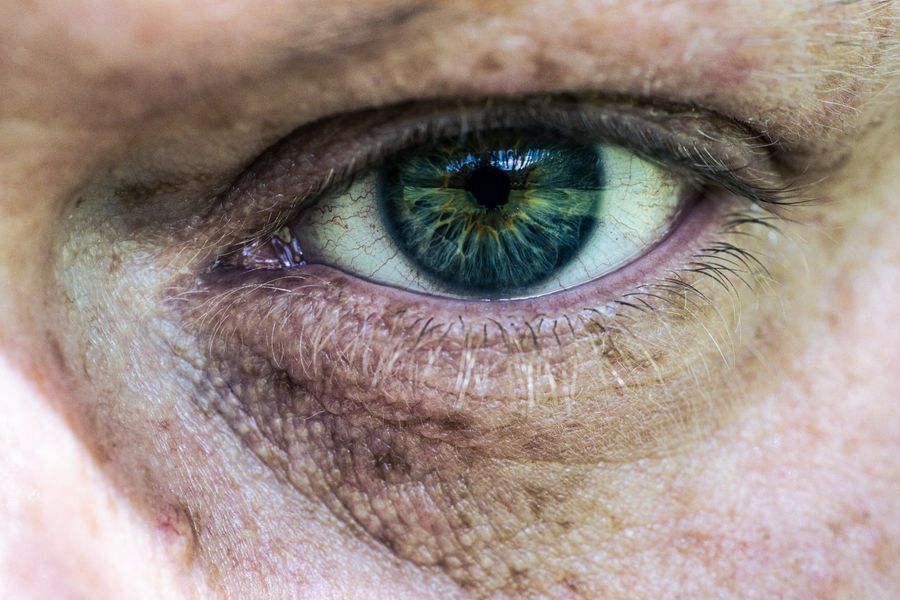
Under-Eye Bags, Hollows, or Dark Circles? A Dermatologist on Which One You Have
Everyone with a tired-looking under-eye assumes they need filler. Most don't. A board-certified dermatologist walks through the skin-pull test you can do in the mirror, the five different problems people call dark circles, and the honest fix for each, including when the real answer is surgery.
Under-eye bags, hollows, dark circles: how do you tell them apart? This is a very complex question, and it is genuinely difficult for patients and for healthcare providers to sort out what’s actually causing that tired look under the eyes.
That matters, because the under-eye is where people spend the most money on the wrong fix. Filler for a problem filler can’t touch. Eye cream for a problem that’s anatomy, not skin. So before you book anything, do the test below and figure out which problem you actually have.
Start with the skin-pull test
If you think you have dark circles, the first thing to do is stand in front of a mirror and gently pull the skin under the eye down and away from the eye, or up and away from the underlying anatomy. Then look: is the skin itself actually pigmented?
This is one of the most common complaints I see, and very often the answer is no. Shadows and thin skin give the illusion of dark circles, but there is no pigment in the skin at all. Once you pull the skin off the contour underneath, the “darkness” disappears, because it was a shadow being cast by a hollow or a bag.
If the darkness stays put when you pull the skin, you have true pigmentation. If it vanishes, you’re dealing with something structural, and no cream will fix it.
That one test splits the under-eye into its different problems. Let’s go through them.
Problem 1: real pigment in the skin
If the skin stays dark when you stretch it, the pigment is in the skin. The good news is that we treat this the same way we treat hyperpigmentation anywhere else on the body, with lightening creams:
- hydroquinone
- retinoids
- vitamin C
- azelaic acid
- kojic acid
- tranexamic acid
- other lighteners
Be patient. Pigment responds slowly, and this skin is thin and sensitive, so it’s an area for a provider to guide, not for aggressive experiments at home.
On eye creams: there are various types on the market that can help with pigmentation, collagen production, or swelling. They are not all the same product in a smaller jar. See an experienced skincare specialist to determine which eye cream, if any, matches your particular problem under the eye.
Problem 2: shadows from a hollow
A lot of people only have shadows. If you have good, thick skin under the eye but there’s a depression, a hollow along the tear trough, the darkness you see is that groove catching light.
This is about the only situation where I would consider under-eye filler. Good skin, a real hollow, and a shadow that disappears when the skin is lifted: that’s the candidate. Filler restores the contour and the shadow goes with it.
Notice how narrow that is. Under-eye filler has become an everything-fix online, and it isn’t. If your problem is pigment, filler does nothing. If your problem is bags, filler is a compromise at best, which brings us to the next one.
If you are entertaining under-eye filler, read this first
Make sure you go to an experienced injector. This is a very tricky area, and it is not an area to bargain hunt for a deal.
We never want to overcorrect here. Everyone actually should have a tear trough, a bit of a depression under the eye, because we all get some swelling with time. Your under-eye needs room to accommodate that occasional swelling, so you never want to fully erase the depression. Less is more. You can always add if you need it.
Filler belongs on bone, not in the orbit. This is a vascular area, and you want an experienced injector to avoid a vascular occlusion or, at the extreme, blindness. That complication is rare, but it is not zero, and obviously none of us want to be anywhere near it.
Filler here can last a long time, and it can move. Even deeply placed hyaluronic acid can sometimes be pumped up toward the surface by the orbicularis oculi, the muscle around the eyelid, with normal muscle movement. That can cause swelling, what we call malar mounds. Occasionally filler in this area needs to be dissolved with hyaluronidase if you develop that swelling.
Placed too superficially, it can show through the skin as a blue-grey colour called the Tyndall effect, which we do not want to produce.
None of this is a reason to panic if you’re a good candidate. It’s a reason to choose the injector on experience, not price.
Problem 3: bags, meaning fat pushing forward
Many people have true bags, which is fat herniation: the fat pad under the eye pushing forward and creating a bulge. Filler can do a somewhat adequate job of concealing these fat pads by filling in around them so the bulge is less obvious. But it’s camouflage, and it has limits.
If you want to get rid of under-eye bags, the real answer is surgery: a lower blepharoplasty. It removes or repositions the fat that’s causing the bulge, and it’s frequently a one-and-done procedure. It also helps a lot of people who have hollows under the eyes, because the surgeon can reposition fat into the hollow while dealing with the bag.
Patients don’t always want to hear “surgery,” and I understand that. But I’d rather tell you honestly that a syringe won’t solve a fat pad than watch you buy filler every year for a problem one procedure could fix.
Problem 4: a bluish tint from veins
Some people have a bluish vein or a general bluish colour under the eye. This is a vascular problem, not pigment and not shadow, and it responds to a vascular type of laser that targets the veins under the eyes. Lightening creams won’t help it, and filler won’t either.
Problem 5: thin skin
Very thin under-eye skin shows everything beneath it, muscle, vessels, the colour of the tissue underneath, and it also creases easily. Here the goal is to thicken and plump the skin itself.
Two routes:
- Skincare that builds collagen and elastin. Retinol or retinoic acid, along with products that hydrate the skin, thicken it gradually over months.
- Procedures. Partially ablative or fully ablative laser resurfacing can thicken the skin. Peels can also be very helpful in this area, such as a modified phenol peel or a TCA peel, to plump the skin.
The lifestyle part
Please make sure you get adequate sleep. And make sure hay fever, allergic rhinitis, or other allergies aren’t contributing to swelling under the eyes. Puffiness from allergies is real, it’s treatable, and it’s a lot cheaper to fix than anything else on this page.
Sleep and allergies won’t create or erase a fat pad or a hollow, though. Those are anatomy. Lifestyle changes how the area looks day to day; they don’t change the underlying structure.
The bottom line
Do the skin-pull test before you spend a dollar. Pigment gets lightening creams. A hollow with good skin is the one case for filler, and only with an experienced injector who under-corrects. Bags mean surgery if you want them gone, or filler as an honest compromise. A blue tint means vascular laser. Thin skin means retinoids, resurfacing, or peels. And check your sleep and allergies first, because that part is free.
Comparing your options? See our guide to under-eye bag treatments compared, and my article on hyperpigmentation and dark spots if the pull test says your problem is pigment.
Find a Dermal Fillers clinic near you
See the clinics in your city that offer it, compare reviews, and request a free consultation.
Your location is used once to pick the nearest city and is never stored.

Dr. Victoria Taraska, MD, FRCPC
Board-Certified Dermatologist
Dr. Victoria Taraska, MD, FRCPC, is a board-certified dermatologist with over 25 years of experience in both medical and cosmetic dermatology. She earned her medical degree from the University of Manitoba, completed internal medicine training there, and finished her dermatology residency at the University of Ottawa. She has been a Fellow of the Royal College of Physicians and Surgeons of Canada in dermatology since 1998, is an active member of the Canadian Dermatology Association and the American Academy of Dermatology, and developed the InforMED patient decision aids for dermatological conditions. Dr. Taraska reviews ClinicCompass treatment content for medical accuracy.
More from Dr. Taraska →This article is for education, not medical advice. Treatment decisions should always be made in consultation with a qualified provider who has examined you.
Keep reading
Dermatology Marketing: How a Derm Practice Fills Its Cosmetic Schedule
A dermatology practice does not lose cosmetic patients to med spas because of price. It loses them because the cosmetic side is hidden behind a medical front desk, a three-month wait and a website written for insurance patients. This is how to give the cosmetic side its own front door and fill it.
Read post → Patient GuideMicroneedling Aftercare and Downtime: The Day-by-Day Guide
Microneedling downtime is short, but the first 48 hours decide whether your result is good. Here is what to expect each day, what to put on your skin and what to keep off it, and the handful of things people do that undo the treatment they just paid for.
Read post → WellnessIs Red Light Therapy Safe? The Risks, the Evidence, and Who Should Skip It
Red light therapy has almost no side effects, which makes it easy to recommend and easy to overpromise. The honest picture: strong evidence for a few uses, thin evidence for most of the claims on the box, and a short list of people who should not sit under the panel.
Read post →Find Dermal Fillers providers in your city
Compare vetted clinics with real Google ratings, see honest local cost ranges, and request a free consultation.