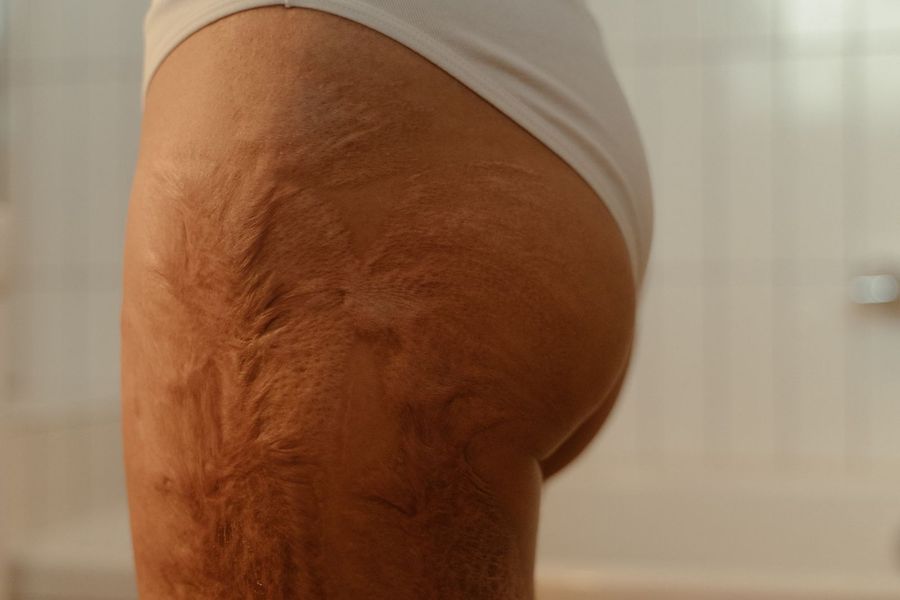

Roughly nine in ten women have some cellulite, including athletes and people who have never been overweight. That statistic is the first clue that it is not about fat. Cellulite is what happens when fibrous bands, called septae, tether the skin to the tissue underneath while the fat between them pushes up. The bands hold the skin down at fixed points and everything around them bulges. That is the dimple.
Once you see it that way, the market makes sense. Creams, wraps, and cardio act on the fat or the surface. They cannot reach the bands. The treatments that work either release the bands or firm the skin so it stops sinking around them.
Two kinds of cellulite, two kinds of fix
Distinct dimples are the classic version: individual depressions you can point to on the thigh or buttock, often visible even when standing relaxed. These are band problems, and the answer is a band-release procedure. A small device or needle cuts the tether under local anesthesia, the skin lifts, and the dimple is gone. One session treats a set of dimples; bruising lasts a couple of weeks. This is the category with the strongest published results, and it is what most people mean when they ask what actually works.
Diffuse texture is the mattress or orange-peel look with no single dimple to point at, usually across a broader area and worse when the skin is pinched. That is more of a skin-quality problem. Radio-frequency and ultrasound tightening thicken and firm the dermis over a series of sessions so it drapes more evenly. Results are subtler and build over months, and they need maintenance, but they suit the version of cellulite that band release cannot address.
Many people have both. A good plan treats the dimples once and the texture on a schedule.
What a realistic result looks like
Smoother, not flawless. Band release removes the treated dimples; it does not make a thigh look like it has never had cellulite, because skin texture, remaining fat, and muscle tone all still contribute. Tightening improves the surface by a degree most patients notice in photos and clothing, not by erasing it. Anyone promising complete removal is describing a result that does not exist in the clinical literature.
Costs run from a few hundred dollars per tightening session to a few thousand for a band-release procedure covering multiple dimples. Because band release is one-and-done, its cost per lasting result is often better than years of maintenance treatments.
How to choose a provider
Ask which kind of cellulite you have and watch whether the answer is specific. A provider who examines you standing, marks the dimples, and explains the band-versus-texture split before naming a device is doing the assessment that decides the outcome. If every patient gets the same machine regardless of what they present with, keep looking.
Ask to see before-and-after photos taken in the same lighting and position. Cellulite photography is easy to flatter with a change of angle.
Browse the clinics below, and treat the consultation as the product you are buying first.