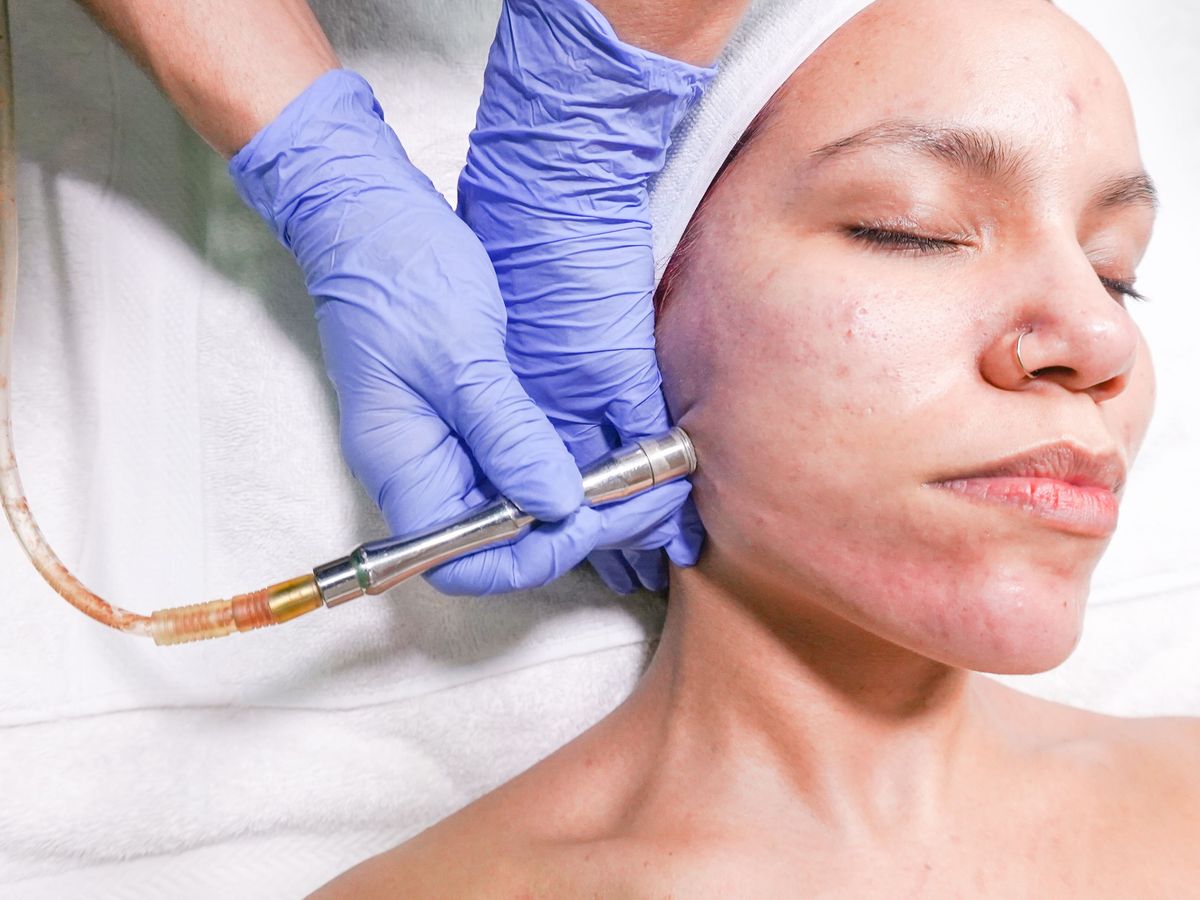
A mechanical exfoliation that buffs away the dead outer layer of skin with a diamond tip or fine crystals, leaving skin smoother and brighter the same day, with no downtime and results that build over a series.
Also called: diamond microdermabrasion, crystal microdermabrasion, diamond peel, microderm facial
Microdermabrasion is one of the oldest treatments on a med spa menu and still one of the most booked, for a simple reason: it delivers visibly smoother, brighter skin in thirty minutes with nothing to recover from. It does not do what a laser or a medium peel does. It does the thing most people want most weeks, which is to look like they slept well.
What the treatment involves
A handpiece with a diamond-crusted tip, or a fine stream of crystals, moves across the skin under gentle suction, abrading the outermost layer of dead cells and drawing them away. The whole face takes twenty to thirty minutes. There is no numbing and no real discomfort, just a scratching sensation. Afterward the skin is pink for an hour or two, feels remarkably smooth, and takes serum and moisturizer far better than before.
Diamond-tip systems have largely replaced crystal ones because they are cleaner, more controllable, and safer near the eyes and on darker skin tones. If a clinic still uses crystals, ask why.
What it improves, and what it does not
Microdermabrasion improves surface texture, dullness, blackheads and congestion, fine lines, mild sun damage, and light superficial scarring, with results that build over a series of four to six sessions and hold with monthly maintenance. It also makes everything applied afterward penetrate better, which is why it is often the first step in a treatment plan.
It does not treat deep wrinkles, deep acne scars, or laxity, and it is rarely used for melasma; those need microneedling, laser, or peels that reach below the surface, chosen carefully in the case of melasma. And it is not for skin that is actively inflamed. A provider who suggests it for cystic acne or rosacea is selling the treatment they have rather than the one you need.
What it costs
Sessions run $75 to $200 depending on the city and whether it is bundled into a facial. A series of four to six is the standard package and the way to get a real change; single sessions are a fine pre-event refresh.
Choosing a provider
Ask whether they use a diamond tip or crystals, how they adjust intensity for your skin, and what they recommend alongside it. Ask what they would not treat. Every trained esthetician can perform microdermabrasion; the good ones know when to say no to it.
Browse the clinics below and compare microdermabrasion pricing and series packages by city.
Why people choose Microdermabrasion
Smoother, brighter skin the same day with no recovery
Unclogs pores and reduces blackheads
Improves the absorption of everything applied afterward
Safe on all skin tones when done with a diamond tip
Are you a good candidate?
Anyone with dull, rough, or congested skin, mild sun damage, fine lines, or light acne scarring who wants a no-downtime refresh; not for active acne, rosacea, or very sensitive skin
By location
Find Microdermabrasion near you
538 clinics across 236 cities list Microdermabrasion on ClinicCompass. 321 of them (60%) say on their own websites that they offer financing or payment plans;
ask about approval and interest before you book.
Typically $75 to $200 per session depending on the city and whether it is bundled with a facial. Most clinics sell a series of four to six at a per-session discount, which is how it is meant to be used; a single session is a pleasant refresh, a series changes the skin.
Microdermabrasion or HydraFacial?
Both exfoliate and neither has downtime. Microdermabrasion is purely mechanical and slightly more aggressive on texture, which makes it the better pick for rough skin, mild scarring, and sun damage. HydraFacial adds suction extraction and infused serums, which suits congested, dehydrated, or sensitive skin. Many clinics offer both and alternate them.
Does it hurt, and what does the skin look like afterward?
It feels like a cat's tongue or fine sandpaper moving across the skin, with mild suction. Afterward the skin is pink for an hour or two and feels tight and smooth. Makeup can go on the same day; sunscreen is essential for a week because the fresh surface burns easily.
Who should skip it?
Anyone with active inflamed acne, rosacea, eczema, open sores, or very reactive skin, and anyone on isotretinoin or who has had a recent peel or laser. The abrasion can inflame those conditions. A good provider checks before treating.
How is it different from dermaplaning?
Dermaplaning scrapes the surface with a blade and removes fine facial hair along with dead skin; microdermabrasion abrades with a tip or crystals and reaches slightly deeper into texture. Dermaplaning is the better choice for peach fuzz and makeup application; microdermabrasion for rough texture and light scarring.
Sources
Where this information comes from
Clinical facts on this page are checked against these primary sources.
1.Microdermabrasion: FAQs, American Academy of DermatologyConfirms the handheld-device mechanism removing the top skin layer, that most patients need a series of treatments (5 to 16) with temporary results needing follow-up maintenance, and that anyone who has taken isotretinoin within the past 6 months has a higher risk of complications including scarring.
2.Microdermabrasion, StatPearls, National Library of Medicine (National Institutes of Health)Confirms the mechanical exfoliation mechanism (removing the stratum corneum under a handheld vacuum system), the crystal (commonly aluminum oxide) versus crystal-free diamond-tip equipment types, that the technique is considered safe across Fitzpatrick skin types with minimal complications, and the contraindications: active cutaneous infection (such as herpes simplex), aluminum-crystal allergy, caution with a history of keloid scarring, and rosacea or telangiectasia as relative contraindications.
3.Microdermabrasion, American Journal of Clinical Dermatology (PubMed, National Institutes of Health)Confirms microdermabrasion is a safe, simple office procedure with mild reported benefit for photoaging, and that despite widespread use its exact mechanism was, at publication, still being characterized.