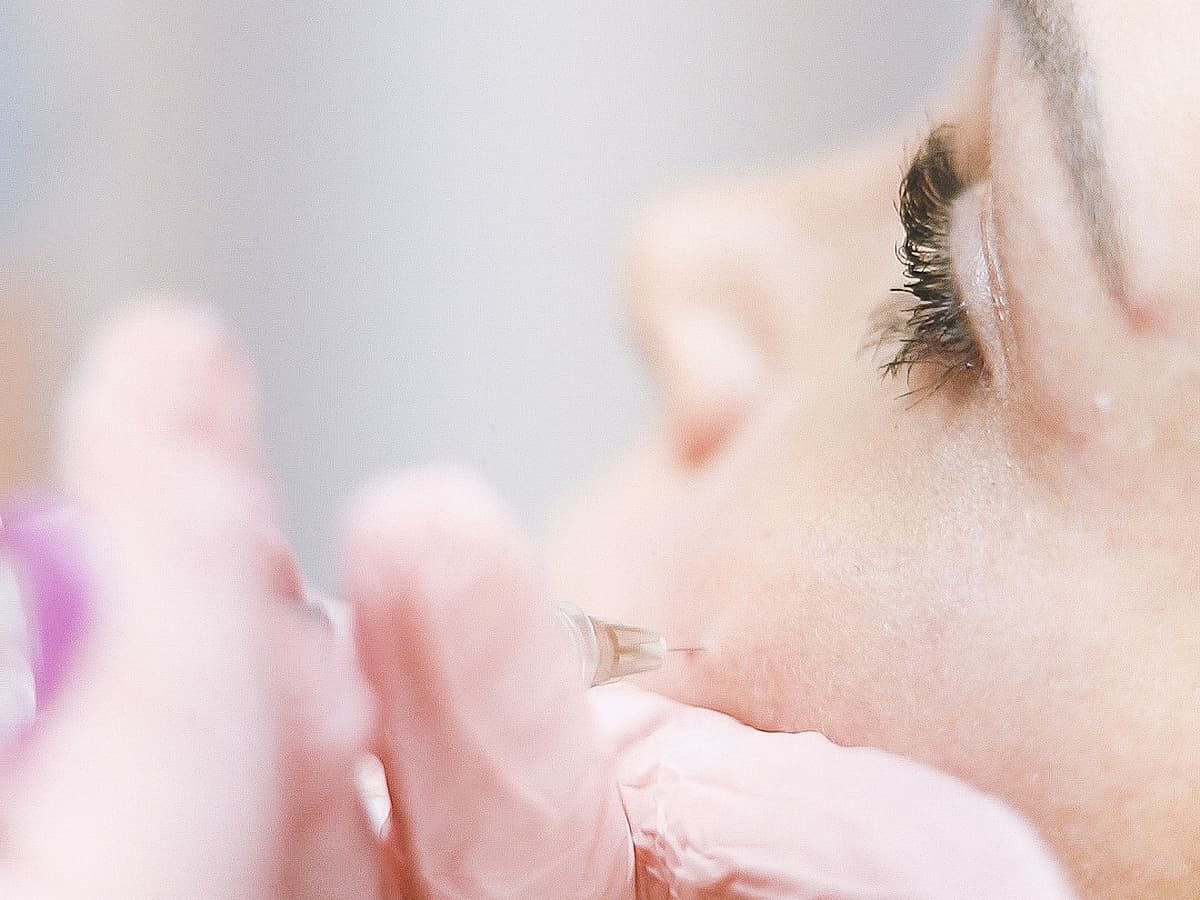
Structural hyaluronic acid filler that restores or enhances cheekbone projection, lifting the midface, sharpening light reflection, and indirectly softening under-eye hollows and nasolabial folds.
Also called: cheekbone filler, midface filler, cheek augmentation
See the clinics in your city that offer it, compare reviews, and request a free consultation.
Your location is used once to pick the nearest city and is never stored.
Cheek filler is the structural treatment of facial aesthetics, the one injectors reach for first, because the midface supports everything around it. Done well, it doesn’t just add cheekbone definition; it subtly lifts the under-eye area above and softens the folds below.
How cheek filler works
With age, the deep fat pads of the midface shrink and slide downward, and cheekbone projection flattens. The knock-on effects spread across the face: deeper tear troughs, heavier nasolabial folds, a tired overall look even on good days.
Structural hyaluronic acid fillers (firmer products designed for deep placement) are injected down at the bone level along the cheekbone. They restore projection where it was lost (or create it where genetics never supplied it), and the overlying tissue re-drapes accordingly.
The result, done properly, is not “bigger cheeks.” It’s better light architecture, the highlight along the cheekbone that photographers and makeup artists spend their careers simulating.
What to expect
A 30–45 minute appointment including numbing. The injector maps your cheekbone structure, then places filler at a few deep points per side, often molding it gently by hand. Results are visible immediately, with 1–3 days of possible swelling or light bruising before things settle. Cheek filler seldom causes much swelling or downtime, but anyone can bruise when a needle is used, and many injectors use a blunt cannula in the cheek to keep that to a minimum.
Full refinement takes about two weeks. Judge nothing in the first 48 hours.
Results and duration
Structural cheek filler lasts 12–18 months. Because placement is deep and the area is low-movement, it wears predictably and gracefully: results fade gradually rather than shifting.
Typical first treatment: 1–2 syringes total. Restraint wins; you can always add at a follow-up.
Is cheek filler right for you?
Strong candidates:
Midface flattening or descent, the classic 35+ volume-loss pattern
Naturally flat cheekbones at any adult age
Under-eye hollows or nasolabial folds, where cheek support may treat the cause rather than the symptom
Anyone wanting a defined, lifted look without surgery
Considerations: very thin faces need conservative dosing; significant skin laxity may call for pairing with skin tightening.
What affects the cost
Syringe count. Priced per syringe ($650–1,400); most treatments use 1–2.
Product tier. Premium structural HA lines cost more and hold shape longer.
Injector expertise. Deep, on-bone placement near vessels demands training. Vascular occlusion, and in the worst case vision loss, is a risk with any filler in any location; the cheek is a low-risk area, and an experienced injector keeps it that way. Pay for it.
Market. Coastal metros price at the top of the range.
Browse cheek filler providers near you on ClinicCompass, and if your volume loss is broad rather than localized, compare with Sculptra.
Why people choose Cheek Filler
Restores youthful midface projection and light reflection
Indirectly improves under-eye hollows and nasolabial folds by re-supporting the midface
Structural HA fillers last 12–18 months here
Immediate results, reversible if ever needed
Are you a good candidate?
Adults with midface volume loss or naturally flat cheekbones wanting lift and definition, and often the smarter first step before treating under-eyes or smile lines directly
By location
Find Cheek Filler near you
6,077 clinics across 433 cities list Cheek Filler on ClinicCompass. 3,129 of them (51%) say on their own websites that they offer financing or payment plans;
ask about approval and interest before you book.
Why do injectors often treat cheeks before under-eyes or smile lines?
Because the midface is the scaffolding. As cheek volume descends with age, it deepens the tear trough above and the nasolabial folds below. Re-supporting the cheek often improves both neighboring areas with less product, sometimes eliminating the need to inject them at all. It's the "fix the foundation first" principle of facial filler.
How many syringes will I need?
Most first-timers use 1–2 syringes split between both cheeks. Significant age-related volume loss can take more, sometimes staged across two visits. Anyone quoting 4+ syringes on a first consult deserves a second opinion.
Will cheek filler look fake?
Overfilled "pillow face" comes from too much product placed too superficially, a technique failure, not an inherent property. Modern structural fillers placed on the bone in moderate amounts create projection, not puff. Review your injector's healed photos, and favor ones whose results you can't detect.
How long does cheek filler last?
12–18 months for structural HA products. The cheek moves less than the mouth area, so product survives well. Collagen-stimulating alternatives like Sculptra last 2+ years but build gradually over months instead of instantly.
Does it hurt?
Modern fillers include lidocaine, and most injectors add topical numbing. Expect pressure more than pain. The cheek is one of the more comfortable filler areas. Soreness for a day or two after is normal.
Cheek filler or Sculptra, which should I choose?
HA cheek filler gives immediate, precisely controllable projection and is reversible. Sculptra stimulates your own collagen for a broader, more gradual re-volumization over 2–3 months that lasts 2+ years, better for global volume loss than sharp definition. Immediate + sculpted → HA. Gradual + overall fullness → Sculptra. Some plans use both.
Sources
Where this information comes from
Clinical facts on this page are checked against these primary sources.
1.Restylane Lyft with Lidocaine: FDA Summary of Safety and Effectiveness Data (PMA P040024/S073), U.S. Food and Drug Administration (CDRH device approval, PMA P040024/S073)Confirms FDA approval of a structural hyaluronic acid filler for subcutaneous-to-supraperiosteal (bone-level) cheek augmentation and correction of age-related midface contour deficiencies, that midface correction persisted through Month 12 in the pivotal trial, that implant-site swelling, bruising, and pain are the most common side effects, and that the product contains lidocaine for injection comfort.
2.Dermal Fillers (Soft Tissue Fillers), U.S. Food and Drug AdministrationStates that swelling and bruising are the most common dermal filler side effects and typically resolve within a few days to weeks, supporting the page's downtime description after cheek filler injection.
3.Dermal Filler Do's and Don'ts for Wrinkles, Lips and More, U.S. Food and Drug AdministrationStates that accidental injection into a blood vessel is the most serious dermal filler risk and can cause skin necrosis, stroke, or blindness, supporting the page's caution that deep, on-bone cheek injection near vessels requires a trained, experienced injector.
4.How Should We Use Hyaluronidase for Dissolving Hyaluronic Acid Fillers?, National Institutes of Health (PubMed Central), Journal of Cosmetic DermatologyConfirms hyaluronic acid filler can be reversed or dissolved with the enzyme hyaluronidase, supporting the page's claim that cheek filler results are reversible if needed.
5.Sculptra: FDA Summary of Safety and Effectiveness Data (PMA P030050/S039), U.S. Food and Drug Administration (CDRH device approval, PMA P030050/S039)Confirms Sculptra (poly-L-lactic acid) is a collagen-stimulating filler given across a series of monthly treatment sessions with effectiveness followed through a 24-month extension study, supporting the FAQ claims that Sculptra builds gradually over months and lasts 2+ years compared to immediate HA cheek filler.