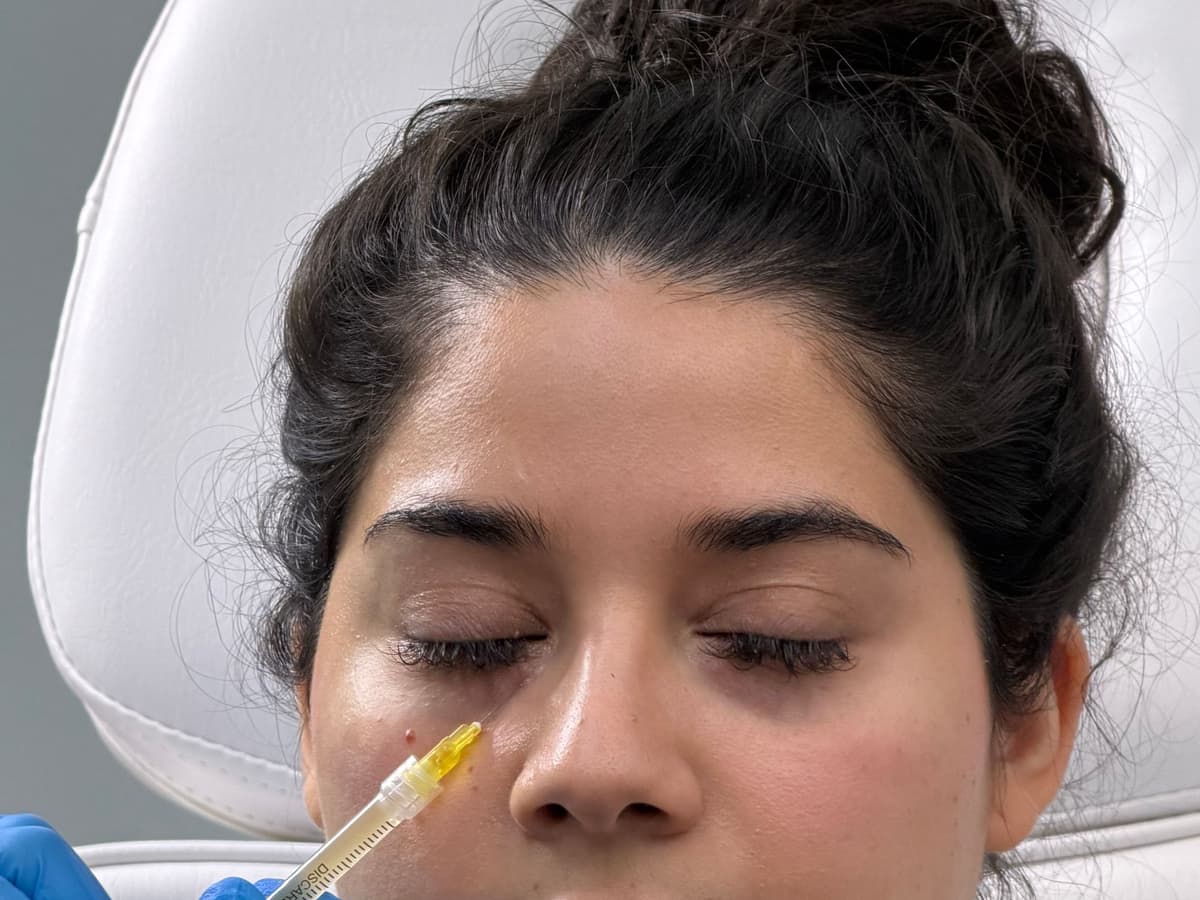
Hyaluronic acid filler placed in the tear trough to smooth under-eye hollows and soften dark circles caused by volume loss, a precision treatment for tired-looking eyes.
Also called: tear trough filler, under eye rejuvenation, dark circle filler
See the clinics in your city that offer it, compare reviews, and request a free consultation.
Your location is used once to pick the nearest city and is never stored.
Under-eye filler (tear trough filler, in clinical language) is the precision play for tired-looking eyes. When under-eye shadows come from genuine hollowness, a small, expertly placed amount of hyaluronic acid filler can erase years of “you look exhausted” in a single appointment.
It is also, frankly, the filler area where injector selection matters most.
How under-eye filler works
The tear trough is the groove that runs from the inner corner of the eye diagonally toward the cheek. With age (or genetics; plenty of people have hollows at 25), fat pads shrink and descend, the groove deepens, and overhead lighting casts a shadow into it. That shadow reads as dark circles and permanent tiredness.
A soft, low-water-absorbing hyaluronic acid filler placed deep along the trough restores the missing volume and eliminates the shadow at its source. Amounts are small (usually 0.5–1 mL per side), and good injectors deliberately under-correct, because filler in this area attracts a little water over the following weeks.
What to expect
The appointment runs 30–45 minutes, most of it assessment and numbing. Placement is by cannula or fine needle depending on the injector’s technique. Expect possible swelling and bruising for a few days, and for some people up to two weeks. Schedule accordingly; concealer handles most of it.
Results are visible immediately, refine over two weeks as swelling resolves, and any small asymmetry is addressed at a two-week review.
Results and duration
The tear trough barely moves, so filler survives here longer than almost anywhere on the face: 12–18 months typically, with some patients passing two years on small top-ups. Because HA filler is dissolvable with hyaluronidase, the treatment is fully reversible, a genuine safety net in this area.
Is under-eye filler right for you?
Filler is the answer when:
You have a true hollow, a groove that catches shadow
Your dark circles fade when you gently stretch the skin or tilt lighting (shadow-based, not pigment)
Your under-eye skin has reasonable thickness
It’s the wrong tool for:
Puffy under-eyes or festoons: filler makes puffiness worse; that’s a lane for skin tightening or surgical consult
Pigmentation-based circles: lasers and brightening treatments instead
Very thin, crepey skin: consider PRP microneedling first to build skin quality
What affects the cost
Injector caliber. This is the area to pay for expertise. High-volume tear-trough injectors price at the top of the range and are worth it.
Filler choice. Softer, tear-trough-appropriate HA products are often premium-priced.
Amount needed. Most patients need one syringe or less; deep hollows occasionally take a second session.
Geography. Major metros run the top of the $600–1,200 range.
Browse under-eye filler providers near you on ClinicCompass, and read their reviews specifically for tear trough work before booking a consult.
Lasts longer under the eyes than most areas, often 12+ months
Reversible (hyaluronic acid filler can be dissolved if needed)
Are you a good candidate?
People with genuine hollowness (a groove between lower lid and cheek) causing shadows, not puffiness, not pigmentation-based dark circles, and with good skin thickness
By location
Find Under-Eye Filler near you
1,067 clinics across 360 cities list Under-Eye Filler on ClinicCompass. 686 of them (64%) say on their own websites that they offer financing or payment plans;
ask about approval and interest before you book.
Only if your dark circles are shadow-based, caused by a hollow tear trough catching shadow. If they're pigmentation-based (brown tones that persist when you look up in the mirror or stretch the skin), filler won't help; lasers or brightening treatments are the right lane. A good injector distinguishes the two in about ten seconds at a consult, and honest ones turn away pigment cases.
Why do some injectors refuse tear trough filler?
Because it's the most technically demanding filler area on the face (thin skin, an unforgiving lymphatic system, and proximity to critical blood vessels). Injectors who don't treat it weekly often refer out. Treat that as a green flag for the ones who do it constantly, not a red flag for the treatment.
How much filler is used under the eyes?
Far less than people fear, typically 0.5–1 mL per side, placed conservatively. Overfilling is the classic mistake; the best results are slightly under-corrected, letting residual filler draw water over the following weeks.
How long does under-eye filler last?
Longer than most areas, commonly 12–18 months, because the tear trough has little muscle movement. Some patients hold results past two years with a small top-up.
What are the risks?
Common and temporary (swelling, bruising, and mild irregularity that settles over 2 weeks). The specific risks of this area are puffiness from over-filling, a bluish tint (Tyndall effect) if placed too shallow, and (extremely rare but serious) vascular occlusion. All three are technique-dependent, which is why injector selection matters more here than anywhere. Hyaluronidase can dissolve HA filler if a correction is ever needed.
Filler or PRP under the eyes, which is better?
Different tools. Filler restores lost volume immediately and lasts a year-plus. PRP (from your own blood) gradually improves skin quality, thickness, and fine crepiness over several sessions but adds no structural volume. Hollow trough → filler. Crepey, thin, darker skin → PRP or microneedling. Both → many practices stage them.
Sources
Where this information comes from
Clinical facts on this page are checked against these primary sources.
1.JUVEDERM VOLBELLA XC Directions for Use, U.S. Food and Drug Administration (CDRH device labeling, PMA P110033/S053)FDA warning that injecting a hyaluronic acid filler into a blood vessel in the face, including the periorbital area, can cause temporary or permanent vision impairment, blindness, stroke, or skin necrosis, backing this page's note that vascular occlusion is a rare but serious risk under the eyes.
2.JUVEDERM VOLBELLA XC Summary of Safety and Effectiveness Data (SSED), U.S. Food and Drug Administration (CDRH, PMA P110033/S053)The pivotal FDA trial for this FDA-approved under-eye hyaluronic acid filler excluded candidates with infraorbital hyperpigmentation, atrophic tear-trough skin, and large lower-lid fat pads that would mask improvement, backing this page's guidance that pigmentation-based dark circles, thin or crepey skin, and puffy under-eyes are not good candidates for filler; also that responder rate (73.4%) and patient satisfaction (75.5%) remained high at the 12-month follow-up, supporting results lasting about a year or longer.
3.Complications after cosmetic periocular filler: prevention and management, National Institutes of Health (PubMed Central), Plastic and Aesthetic ResearchThe Tyndall effect (bluish discoloration) results from superficial hyaluronic acid filler placement in the thin tear-trough skin and is treated by flooding the area with hyaluronidase; vascular occlusion near the tear trough can send emboli backward into the ophthalmic artery and cause vision loss; and festoons or puffiness often become more noticeable after filler injection, backing this page's guidance against treating puffy under-eyes with filler.
4.Treating Tear Trough Deformities With Dermal Fillers, American Academy of Ophthalmology, EyeNet MagazineSkin quality and thickness are described as the most important factor in candidacy for tear-trough filler, patients are warned about the Tyndall effect, and reinjection intervals average about a year, backing this page's skin-thickness candidacy guidance and its 12 to 18 month duration claim.
5.Dermal Filler Do's and Don'ts for Wrinkles, Lips and More, U.S. Food and Drug AdministrationStates that the most serious risk of dermal filler is accidental injection into a blood vessel, which can cause skin necrosis, stroke, or blindness, and that only a licensed, experienced injector should perform the treatment, backing this page's emphasis on injector selection and vascular occlusion risk.