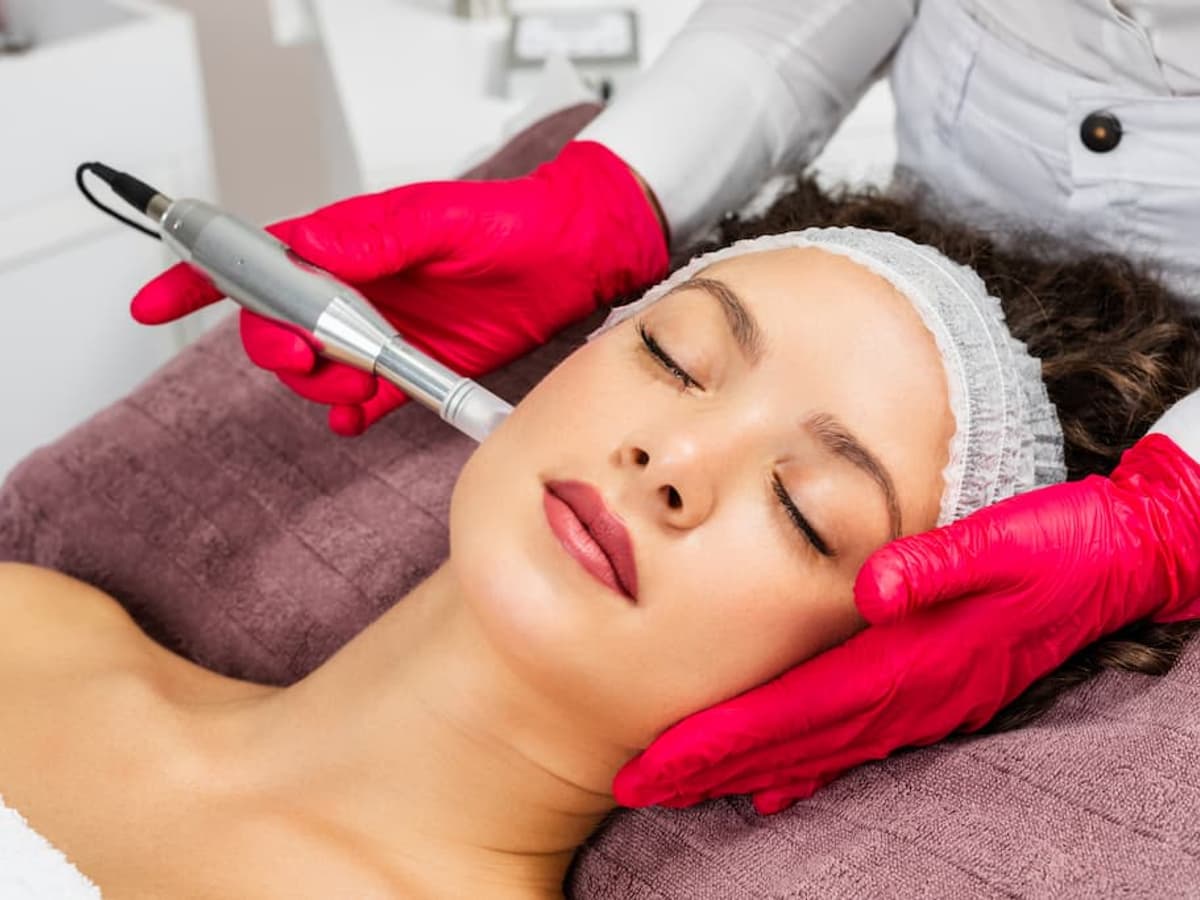
PRP Microneedling (popularly known as the “Vampire Facial”) combines two evidence-based skin rejuvenation approaches into one supercharged treatment. By applying your body’s own platelet-rich plasma (PRP) to micro-needled skin, the treatment delivers a measurable boost in collagen production, skin texture, and tone improvement over standard microneedling alone.
This guide covers what the Vampire Facial actually involves, how it works, what to realistically expect, and how it compares to alternatives.
How PRP microneedling works
The treatment combines two proven techniques:
Step 1: Blood draw + PRP separation
A small amount of your blood is drawn from your arm (similar to a standard blood test). The vial is placed in a centrifuge that spins at high speed to separate the components: the platelet-rich plasma (PRP) is extracted from the red blood cells. PRP is a yellowish liquid concentrated with growth factors that drive tissue repair and collagen formation in your body.
Step 2: Microneedling
Tiny needles (0.5mm–2.5mm depth) create controlled micro-channels in your skin. This triggers your natural wound-healing response: collagen production, cellular turnover, increased blood flow.
Step 3: PRP application
The PRP is applied topically to the skin (where it penetrates the micro-channels deeply) and sometimes injected at strategic points. The growth factors in PRP amplify the healing response, and clinical studies report better results than microneedling alone.
The combined effect: collagen rebuilds over 3–6 months, gradually improving skin texture, tone, acne scars, fine lines, and pore appearance.
What it actually treats
Strong indications:
- Acne scarring (especially rolling and shallow boxcar scars)
- Fine lines and early wrinkles (forehead, around eyes)
- Enlarged pores
- Uneven texture
- Dull or uneven skin tone
- Mild skin laxity (early sagging)
- Stretch marks (when done on body areas)
Less effective for:
- Deep ice-pick acne scars (often need subcision + laser)
- Severe sagging (better addressed with threads, RF, or surgical lift)
- Pigmentation issues (lasers or topicals more effective)
Realistic results and timeline
PRP microneedling delivers progressive results, not instant change:
- Day 1–7: Mild swelling, redness, then “glow” effect from increased blood flow
- Weeks 2–4: Initial improvements in texture and tone visible
- Weeks 6–12: Collagen building accelerates; visible scar improvement starts
- Months 3–6: Peak results from a single session
- After 3-session series: Best results, significant cumulative improvement
Most patients see meaningful improvement after the first session, with dramatic results after the full recommended series of 3 sessions spaced 4–6 weeks apart.
How it compares to alternatives
| Treatment | What it does | Downtime | Cost |
|---|---|---|---|
| PRP Microneedling | Collagen + tone + texture | 1–3 days | $500–$1,500/session |
| Standard Microneedling | Collagen, less robust | 1 day | $200–$700/session |
| Morpheus8 RF | Deeper collagen + tightening | 2–5 days | $700–$1,500/session |
| Laser Resurfacing | Stronger texture/scarring fix | 5–14 days | $500–$3,500/session |
| Chemical Peels | Surface renewal | 0–14 days | $100–$800/session |
PRP Microneedling sits in a sweet spot: more powerful than regular microneedling, less downtime than ablative laser, more natural than synthetic injectables.
Vampire Facial vs. Vampire Facelift
These get confused often:
- Vampire Facial = topical PRP applied after microneedling (what most med spas offer). Cost: $500–$1,500.
- Vampire Facelift = PRP injected with dermal filler for volume + skin quality (more invasive, more dramatic). Cost: $1,500–$4,000. Performed by physicians or experienced injectors, not at most standard med spas.
The names are similar but the treatments are meaningfully different in depth, technique, and price.
What to look for in a provider
PRP quality varies significantly between providers. The right med spa will:
- Use medical-grade PRP centrifuges (Eclipse, Selphyl, Magellan): these produce higher-concentration PRP than basic centrifuges
- Use modern microneedling devices (SkinPen, Eclipse MicroPen, Rejuvapen NXT), FDA-cleared with adjustable depth
- Have licensed RNs or NPs performing the procedure
- Use proper sterile technique for both the blood draw and the application
- Be transparent about which devices and PRP system they use
Browse PRP Microneedling / Vampire Facial providers near you on ClinicCompass to compare local pricing and book a consultation.
Where to compare PRP microneedling (vampire facials)
PRP microneedling pricing depends on the number of sessions and the PRP system used. Compare New York, Los Angeles, Miami, and Austin. For deeper resurfacing, compare against standard microneedling and Morpheus8.