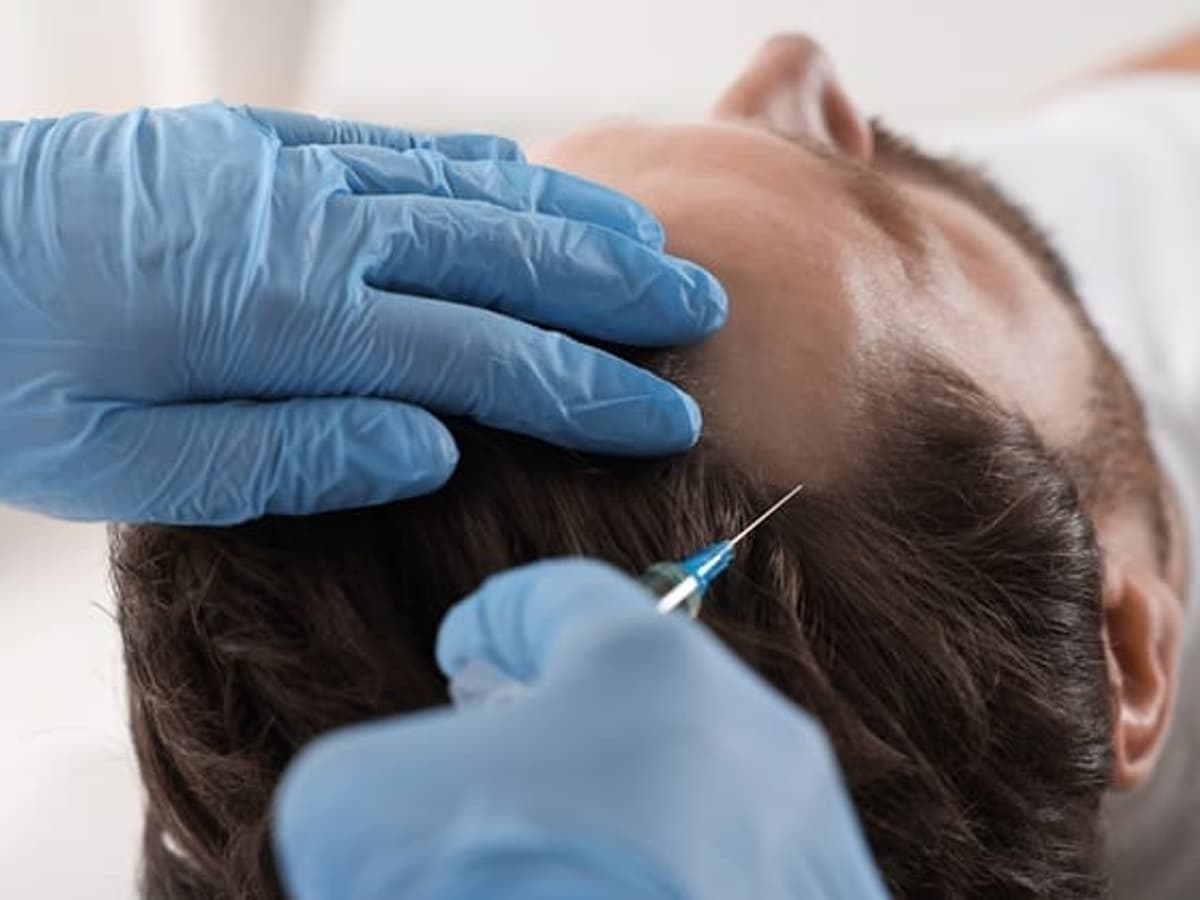
Non-surgical hair restoration has become one of the fastest-growing categories at med spas, combining PRP injections, prescription medications, microneedling, and newer treatments like exosomes and ultrasound-based therapies to slow hair loss and stimulate measurable regrowth. For patients with early-to-moderate pattern hair loss who want to avoid (or delay) hair transplant surgery, these protocols can produce real, measurable density improvement.
This guide covers what non-surgical hair restoration actually involves, what works, what the costs are, and how to choose between the major options.
Who benefits from non-surgical hair restoration
Strong candidates:
- Early-to-moderate male pattern hair loss: receding temples, thinning crown, but follicles still present
- Female pattern hair loss: overall thinning, widening part, reduced density at the crown
- Postpartum hair shedding that hasn’t resolved on its own
- Telogen effluvium (stress-induced shedding)
- Hair thinning from hormonal changes, medications, or aging
Not appropriate for:
- Significantly bald areas where follicles are gone (only transplant can fix)
- Active alopecia areata (autoimmune patchy loss; needs dermatologist evaluation)
- Scarring alopecia (medical condition requiring medical management)
- Active scalp infections or psoriasis
The major treatment options
PRP Injections (Platelet-Rich Plasma)
Blood is drawn from your arm, spun in a centrifuge to extract platelet-rich plasma, then injected throughout the scalp into thinning areas. The growth factors in PRP stimulate dormant follicles and extend the hair growth phase.
Typical protocol: 3–4 sessions, 4–6 weeks apart, then quarterly maintenance. Cost: $500–$1,200/session.
Strongest evidence: A majority of patients in studies see improvement in hair density.
Minoxidil (Topical and Oral)
The most-prescribed hair loss medication. Topical (Rogaine, brand and generic) works directly on the scalp. Oral minoxidil is increasingly prescribed off-label by dermatologists and progressive med spas.
Typical cost: $25–$60/month for topical; $30–$80/month for oral.
Works while you take it. Stopping = gradual return to previous loss rate.
Finasteride (Oral)
DHT-blocker that’s the most effective single treatment for male pattern hair loss. Slows or stops the underlying hormonal driver. Note: side-effect concerns in a subset of men (sexual side effects, mood changes). Discuss honestly with prescribing provider.
Cost: $25–$80/month.
Exosomes
Newer, more expensive treatment using stem-cell-derived exosomes (not from your blood). Early data suggests stronger effects than PRP, but research is still emerging.
Cost: $1,500–$3,500/session.
AlmaTED (Ultrasound + Topical Serum)
Non-injection alternative: uses ultrasound to drive a topical serum into the scalp. No needles, no downtime. Newer to market with growing but earlier-stage evidence.
Cost: $500–$900/session.
Low-Level Laser Therapy (LLLT) / Red Light Helmets
At-home or in-office device-based treatment using red light wavelengths to stimulate follicles. The most accessible add-on to other treatments.
Cost: $1,000–$2,500 one-time for at-home device.
What works best: the combination protocol
For most patients, combining 2–3 modalities outperforms any single treatment:
- Standard combination: PRP + topical minoxidil + (for men) oral finasteride
- Premium combination: Exosomes + AlmaTED + medications
- Budget combination: Topical minoxidil + at-home laser device + finasteride if applicable
The combined approach addresses both follicle stimulation (PRP, exosomes, lasers) and the underlying driver of loss (medications).
Realistic results and timeline
Honest expectations:
- Month 1–2: Reduced shedding (often the first sign things are working)
- Month 3–4: Visible thickening of existing hairs; some new “baby hair” growth
- Month 6: Full results from initial PRP series visible
- Month 12+: Maintained or continued improvement with ongoing treatment
What you won’t see:
- Hair filling in completely bald areas (only transplant can do that)
- Dramatic results in 1–2 sessions
- Permanent results without ongoing maintenance
When to see a dermatologist vs. a med spa
See a dermatologist first if:
- Your hair loss is sudden or patchy
- You have scalp inflammation, itching, or visible scaling
- The pattern doesn’t match typical male/female pattern hair loss
- You want to rule out medical causes (thyroid, iron deficiency, autoimmune)
A med spa is a fine starting point if:
- You have confirmed pattern hair loss
- You’re ready to commit to a multi-session protocol
- You want PRP + topicals + maintenance without separate appointments
Many of the best med spas have physician oversight and can both diagnose and treat. Bring photos of your hair from 1, 3, and 5 years ago to help your provider assess the progression.
What to look for in a provider
- Medical director (MD) involved in the treatment plan
- PRP centrifuge quality: medical-grade equipment (Eclipse, Selphyl, Magellan)
- Willingness to combine modalities (some med spas only offer PRP; the better ones combine PRP with medication management)
- Honest assessment of candidacy: providers willing to tell you “this won’t work for you, see a transplant surgeon” are providers worth trusting
Browse Hair Restoration providers near you on ClinicCompass to compare local pricing and book a consultation.
Where to compare hair restoration
Non-surgical hair restoration (PRP, exosomes, medications) is usually sold as a series, so total cost matters. Compare Dallas, Miami, Chicago, and Toronto. Many clinics combine it with PRP microneedling or IV therapy for overall wellness.